

You’ve probably been told time and time again that your credit score is incredibly important. News outlets loudly proclaim the importance of maintaining an excellent credit score, going to great lengths to convince you that your credit score is an integral part of your financial life (and selling you on the newest monitoring tool to help you keep track of your progress).
You may want to buy a house someday. Or a car loan. Forget that you don’t have money saved for a downpayment and often struggle to pay your rent. Pay no attention to the fact that you could save for a car if you didn’t have to turn over your entire paycheck to credit card companies.
Though credit scores are the keys to unlocking the door of credit availability – you aren’t getting a decent mortgage with a lousy credit score – it’s important to recognize they don’t do what they say they do.
The reality is that a good credit score feels like a passport to a world of financial freedom yet serves only to measure your willingness to take on debt and, thereby, feed the banking system’s profit margins.
In other words, focusing solely on your credit score decreases your chances of becoming financially secure.
Factors That Make Up Your Credit Score
Your credit score (there are several credit scoring models, but I’ll discuss them as a single entity) is a three-digit number comprised of five separate components. These components work together to paint a comprehensive picture of your creditworthiness for lenders and financial institutions.
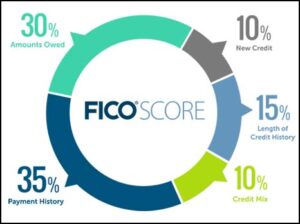
- Your payment history is the most significant factor in your credit score, accounting for 35% of the total. Late or missed payments can have a significant impact on your score.
- Credit utilization, or the ratio of your outstanding balances to your credit limits, makes up 30% of your credit score. A high credit utilization rate can negatively affect your score.
- The length of your credit history accounts for 15% of your credit score. A longer credit history is generally seen as more favorable.
- The types of credit you have, such as credit cards, mortgages, and auto loans, make up 10% of your credit score. A diverse mix of credit types can be beneficial.
- New credit inquiries, which occur when you apply for new credit, account for the remaining 10% of your credit score. Too many inquiries in a short period can hurt your score.
Credit Scores Don’t Tell the Truth
In the last section, I told you the goal is to paint a comprehensive picture of your creditworthiness for lenders and financial institutions. None of the components of your credit score contributes to that goal.
Someone who saves all their money or takes on no debt will inevitably have no credit score. No matter how much they have in the bank, they’ll be hard-pressed to get a vehicle loan at a reasonable interest rate.
People who come to the United States from other countries typically have no credit history.
Medical problems that wipe out someone’s savings and ability to earn a living may temporarily reduce their ability to pay their debts, leading to a reduced credit score.
Credit scores also don’t consider differences in race, age, gender, race, salary, or where someone lives. A 2021 study found substantial racial disparities in credit scores, and other studies clearly show that residents of Northern states have a distinct credit score advantage over their Southern counterparts. And a November 2020 analysis from the Federal Reserve Bank of New York found the higher the income level, the higher the average credit score.
By those measures, a Southern black woman who’s never borrowed a dime in her life, earns $40,000 a year, and has saved $300 a month for the past 15 years is statistically less likely to have a good credit score than a White guy in Minnesota earning $85,000 who makes his minimum payments on a stack of credit cards yet has no savings in the bank.
Tell me again how a credit score accurately measures someone’s financial situation.
Chasing a Credit Score is a Poor Person’s Game
Credit scores measure how well you have paid your debts in the past. Rather than painting a picture of your financial stability or trustworthiness, they do the opposite – they signal your reliance on institutional lenders to meet your basic financial needs.
Wealthy people are less likely to rely on credit, using it as a tool rather than a lifeline. The richest people don’t worry about their FICO score because, for them, debt is an option rather than a necessity.
The rest of us are subject to a constant barrage of marketing messages reminding us that a high credit score is the only way to prove our worthiness in the world. We pay for monitoring services, check our credit reports regularly, and lose sleep over a single late payment because it will tank our credit score.
In my law practice, my bankruptcy clients often forego necessary medical care to keep up the minimum payments on their credit cards. They drive without insurance and subsist on Dollar General dinners because they’ve been indoctrinated into the cult of a good credit score.
By heavily marketing the importance of credit scores, credit reporting agencies and financial institutions further reinforce the belief that a high score is essential for financial success. In the process, they make $120 billion in credit card interest and fees each year. Services like Credit Karma (owned by Intuit, the makers of QuickBooks and TurboTax) raked in $375 million in 2022. largely by scaring people into believing a credit score was the path to a better life.
The wealthy make money by convincing everyone to play a game that keeps them poor.
Instead of Focusing On Your Credit Score
Instead of obsessing over your credit score, consider building a strong financial foundation. Create an emergency fund, save for retirement, and invest in assets that can grow your wealth over time. Cut your expenses mercilessly.
If you’re in debt and can pay it off in the next 12-24 months, do that. If not, consider bankruptcy – any other debt relief solution is going to tank your credit score and require you to pay at least a portion of your high-interest debt.
Spend time learning about personal finance. Be critical of any advice, making sure a tactic is right for you before committing to a course of action. This will help you make better financial decisions and achieve long-term financial goals.
Prioritize your physical and mental well-being.
Recognize you’ve been playing the wrong game, one you win by losing.
Shift your focus, consider your financial goals, and forget the number.
ABOUT THE AUTHOR
Meet Jay
 Since I became a lawyer in 1995, I’ve represented people with problems involving student loans, consumer debts, mortgage foreclosures, collection abuse, and credit reports. Instead of gatekeeping my knowledge, I make as much of it available at no cost as possible on this site and my other social channels. I wrote every word on this site.
I’ve helped thousands of federal and private student loan borrowers lower their payments, negotiate settlements, get out of default and qualify for loan forgiveness programs. My practice includes defending student loan lawsuits filed by companies such as Navient and National Collegiate Student Loan Trust. In addition, I’ve represented thousands of individuals and families in Chapter 7 and Chapter 13 bankruptcy cases. I currently focus my law practice solely on student loan issues.
I played a central role in developing the Student Loan Law Workshop, where I helped to train over 350 lawyers on how to help people with student loan problems. I’ve spoken at events held by the National Association of Consumer Bankruptcy Attorneys, National Association of Consumer Advocates, and bar associations around the country. National news outlets regularly look to me for my insights on student loans and consumer debt issues.
I’m licensed to practice law in New York and California and advise federal student loan borrowers nationwide.
continue reading